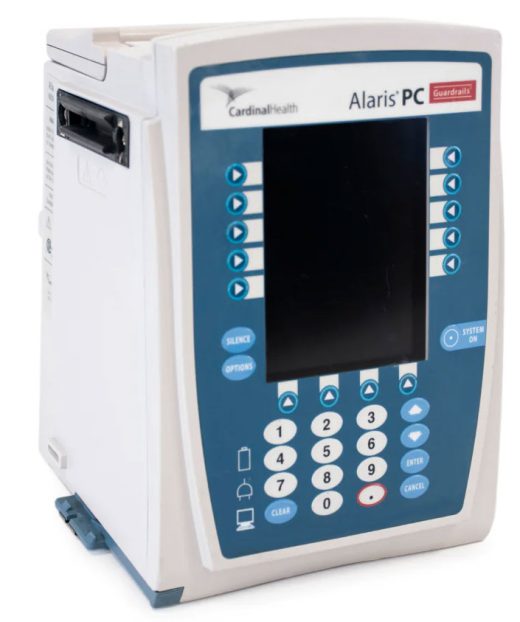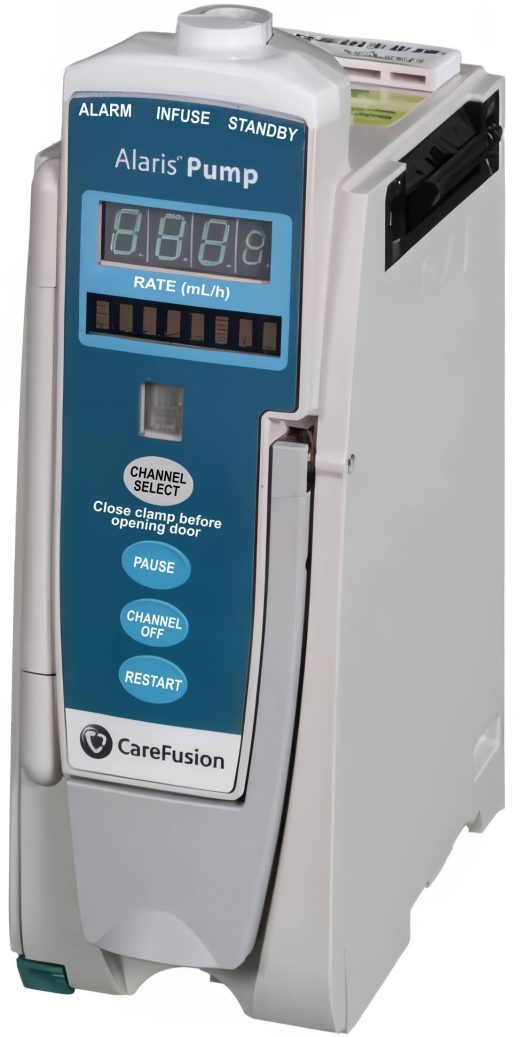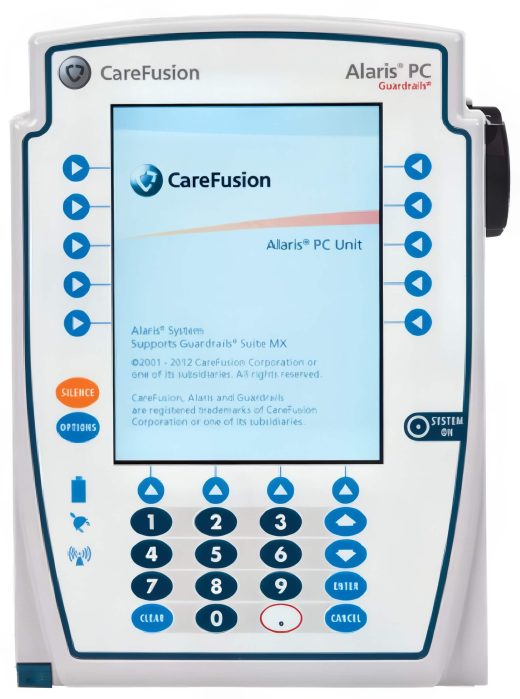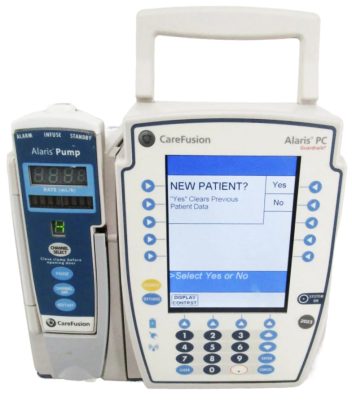
The Alaris 8100 is a large‑volume infusion pump module designed to work as part of the modular BD Alaris System (formerly CareFusion). In hospitals, you usually see it attached to a central Point‑of‑Care Unit (PCU), which provides the display, user interface, and safety software (Guardrails dose error reduction system).
Used together, the 8100 and PCU form a “smart pump” platform that standardizes IV medication delivery across multiple clinical areas: medical‑surgical floors, ICUs, EDs, ORs, and pediatric units.
Note: Details below are general and not a substitute for the official operator’s manual or institutional training. Always refer to manufacturer documentation and hospital policy for exact specifications and instructions.
System Architecture: How the Alaris Modules Work Together
The BD Alaris System is modular:
- Alaris PCU (Point‑of‑Care Unit, e.g., model 8015)
The central controller with screen, keypad, battery, and networking. It powers and coordinates all attached modules. - Alaris 8100 Pump Module
A large‑volume infusion module for delivering fluids, medications, blood and blood products.
Multiple modules can be attached to one PCU to build a patient‑specific configuration—e.g., several 8100 pumps plus a syringe module or monitoring module.
Alaris 8100 Infusion Pump Module
Intended Use
The Alaris 8100 is a large‑volume, channel‑based infusion pump intended for controlled IV administration of:
- Crystalloids (e.g., saline, dextrose solutions)
- Colloids
- Medications (continuous or intermittent)
- Blood and blood products
- Parenteral nutrition and lipids (per institutional policy)
It is designed for adult, pediatric, and neonatal patients when programmed and used by trained healthcare professionals within defined drug libraries and protocols.
Key Features of the 8100 Pump Module
1. Large‑volume, peristaltic infusion technology
- Volumetric pump using a dedicated pumping segment in the IV set
- Designed for accurate delivery of large‑volume infusions
- Compatible with specific BD/Alaris infusion sets incorporating anti–free‑flow protection
2. Smart pump safety with Guardrails
- Relies on the PCU’s Guardrails Dose Error Reduction System (DERS)
- Supports:
- Weight‑based dosing (e.g., mcg/kg/min)
- Standard mL/hr programming
- Volume‑to‑be‑infused (VTBI) over time
- Applies drug‑specific soft and hard limits and alerts based on a hospital‑defined drug library
3. Primary and secondary (piggyback) infusions
- Allows a primary infusion (e.g., maintenance fluids) with a secondary infusion (e.g., antibiotic piggyback) through the same line
- Automates switching between secondary and primary according to programmed parameters
4. Flexible clinical profiles
- Multiple configurable “profiles” or care areas (e.g., Med‑Surg, ICU, NICU, Oncology, OR), each with:
- Its own drug library
- Tailored limits and clinical advisories
5. Channel‑based design
- Each 8100 is a single channel; multiple channels/modules can be stacked on one PCU
- Facilitates independent control of multiple concurrent infusions for one patient
6. Safety and alarm features
Typical safety functions include:
- Upstream and downstream occlusion detection
- Air‑in‑line detection and alarm
- Detection of free‑flow risks via dedicated anti–free‑flow mechanisms in the sets
- Door open / misload detection
- Audible and visual alarms with clear status indication at the channel and on the PCU
7. Integrated event logging
- Logs alarms, changes in settings, start/stop events, and overrides of Guardrails limits
- Supports quality improvement, incident review, and compliance monitoring
Typical Technical Characteristics (High‑Level)
While exact numbers vary by configuration and region, these are the typical specification categories for the 8100 module:
- Pump type: Large‑volume peristaltic pump
- Infusion modes:
- Rate (mL/hr)
- VTBI over time
- Weight‑based dosing (e.g., mcg/kg/min, units/kg/hr) when used with Guardrails
- Therapies: Continuous, intermittent, primary/secondary, keep‑vein‑open (KVO)
- Accuracy: Designed to meet or exceed international infusion device standards (e.g., IEC 60601‑2‑24) for large‑volume pumps
- Power: Receives power and control from the PCU; no separate battery in the module
- User interface: Programming and monitoring via the PCU’s display; the module provides status lights and labels
For exact flow ranges, accuracy percentages, dimensions, and weight, you should reference the official BD Alaris 8100 technical datasheet or operator’s manual, as these are treated as regulated specifications.
Alaris PCU – Point‑of‑Care System
The Alaris PCU is the central “brain” and interface of the system. It ties together the 8100 pump modules and other modules into a single, coordinated platform at the bedside.
Core Functions
1. Central user interface
- Color or monochrome screen (depending on generation) with soft keys and keypad
- Provides:
- Drug selection, rate/dose programming
- Alarm details and troubleshooting prompts
- Overview of all active channels on that PCU
- Supports care area (profile) selection on startup so that the right drug library and limits are loaded (e.g., ICU vs Med‑Surg)
2. Guardrails Dose Error Reduction System (DERS)
Guardrails is the primary safety software layer:
- Hospital‑defined drug library:
- Standard concentrations and dosing units
- Minimum and maximum rates/doses for each therapy
- Weight ranges, infusion duration constraints
- Clinical advisories or warnings
- Soft limits: Can be overridden with clinical justification, but the event is logged
- Hard limits: Cannot be overridden; require reprogramming within safe bounds
Benefits:
- Reduces programming and decimal errors
- Helps standardize practice across units and shifts
- Provides data for continuous quality improvement (e.g., alerts on how often limits are approached or overridden)
3. Modular configuration and expandability
- Multiple infusion and monitoring modules can be attached to a single PCU for one patient
- Common examples:
- 2–4 Alaris 8100 pump channels for fluids, vasoactive drips, maintenance meds
- 1 syringe module for very low‑rate, high‑concentration drugs
- 1 PCA module for post‑operative analgesia
- All modules share a common alarm system and user interface through the PCU
4. Power and battery backup
- Internal battery in the PCU supports continued operation of all attached modules for a limited time during transport or power outages (hours, depending on configuration and load)
- Line‑powered through standard AC mains when docked or plugged in
5. Connectivity and integration (where implemented)
Depending on configuration and hospital IT infrastructure, the PCU may support:
- Network connectivity (wired and/or wireless) for:
- Drug library distribution and updates
- Centralized logs and analytics
- Firmware updates
- EMR/EHR integration (smart pump interoperability), which can include:
- Auto‑documentation of infusion data into the electronic record
- Auto‑programming from the EHR (orders → pump), reducing manual keying
- Closed‑loop medication safety when combined with barcoding and CPOE
Actual connectivity options vary by software version, regulatory status in each country, and specific hospital implementation.
Typical Clinical Use Cases
The Alaris 8100 with PCU is designed for professional use in a range of settings.
1. General Medical‑Surgical Units
Common uses:
- Maintenance IV fluids (e.g., saline, dextrose)
- Intermittent IV antibiotics via secondary (piggyback) infusions
- Electrolyte replacement (e.g., potassium, magnesium) within Guardrails limits
- Hydration for patients unable to take adequate oral fluids
Benefits:
- Standardized medication delivery and workflows
- Reduction in programming errors through Guardrails libraries
- A scalable system—additional channels/modules can be added if a patient’s needs escalate
2. Intensive Care Units (ICU, CCU, NICU, PICU)
In critical care, the 8100 is often used alongside other modules:
- Continuous vasoactive drugs (e.g., inotropes, vasopressors)
- Sedation infusions and analgesia (where large‑volume devices are appropriate)
- Parenteral nutrition (TPN) and lipids
- High‑risk titratable medications requiring very precise rates
- Neonatal and pediatric fluid and medication infusions (with dedicated pediatric profiles and weight‑based dosing)
Benefits:
- Multiple 8100 channels allow simultaneous, independently controlled infusions
- Guardrails limits can be tightened for high‑risk drugs
- Centralized view of all active therapies on the PCU facilitates complex ICU workflows
3. Emergency Department and Perioperative Settings
Use cases:
- Rapid initiation of fluid resuscitation after stabilization
- Controlled medication infusions (e.g., antiarrhythmics, antihypertensives)
- Perioperative antibiotics and maintenance fluids in pre‑/post‑op areas
- Transition of infusions from ED to ICU/ward without changing hardware
Benefits:
- Consistent platform across departments, simplifying handoffs
- Guardrails reduces reliance on mental math during high‑stress situations
- Battery backup and modularity support safe patient transport within the hospital
4. Oncology and Specialized Infusions
In oncology and other specialized areas (subject to local policy and protocols):
- Standardized delivery of certain chemotherapy agents
- Complex protocols with staged infusions (pre‑hydration, drug, post‑hydration)
- Supportive therapies: antiemetics, analgesics, biologics, immunotherapies
Benefits:
- Drug‑specific limits and advisories in Guardrails for high‑risk agents
- Detailed logging for documentation and auditing of high‑alert medications
Many institutions use specialized protocols and additional verification steps (e.g., pharmacy double‑checks, barcode administration) for chemotherapy and other high‑risk infusions beyond what the pump alone provides.
5. Pediatrics and Neonatology
With appropriately configured pediatric/neonatal profiles:
- Weight‑based dosing with strict limits and customized drug lists
- Low‑volume maintenance fluids and continuous medication infusions
- Carefully controlled electrolyte and nutrition solutions
Benefits:
- Reduced risk of decimal or miscalculation errors
- Library‑based dosing ranges tailored to very small patients
- Ability to standardize around weight‑based protocols
In very low‑flow, high‑concentration pediatric therapies, syringe pumps (e.g., Alaris 8110) are often used alongside 8100 modules.
Implementation and Safety Considerations
When hospitals deploy the Alaris 8100 and PCU system, typical focus areas include:
- Drug library design and maintenance
- Multidisciplinary team (pharmacy, nursing, physicians, biomedical engineering, informatics)
- Regular review of limits based on incident data and evolving evidence
- Ongoing updates pushed to all devices
- Training and competency
- Initial and periodic staff training on:
- Selecting the correct profile
- Using Guardrails effectively
- Responding to alarms
- Orientation for new staff and travelers
- Initial and periodic staff training on:
- Governance and analytics
- Reviewing Guardrails logs to see:
- Which limits are frequently approached or overridden
- Where protocols or education need adjustment
- Monitoring alarm burden and optimizing settings
- Reviewing Guardrails logs to see:
- Maintenance and regulatory compliance
- Scheduled preventive maintenance and performance verification by biomedical engineering
- Implementation of manufacturer and regulatory safety notices, recalls, and software updates
Buy your Alaris 8100 Infusion Pump and Alaris Point of Care System From Auxo Medical
The Alaris 8100 Infusion Pump Module, integrated with the Alaris PCU Point‑of‑Care System, provides a flexible, modular “smart pump” platform for controlled IV therapy across a wide range of clinical settings.
Key strengths of the system include:
- Modular architecture to tailor the setup to each patient
- Guardrails DERS for standardized, safer dosing
- Support for diverse infusion types—primary, secondary, weight‑based, and VTBI
- Integration capabilities with hospital networks and EHRs (where implemented)
-
Alaris Medley 8100 Infusion Pump
$995.00 The Alaris Medley 8100 Infusion Pump Module is a high-capacity, large-volume infusion device designed to seamlessly integrate into the modular Alaris System, operating in conjunction with the Alaris PC Point of Care Unit (Models 8000 or 8015). Compact and lightweight,… -
Alaris Medley 8015 Point of Care Module
$725.00 The Alaris Medley 8015 Point of Care Module is a versatile, modular infusion and monitoring system designed for adult, pediatric, and neonatal care, providing clinicians with a unified interface for programming and managing multiple channels simultaneously. This compact unit, weighing…